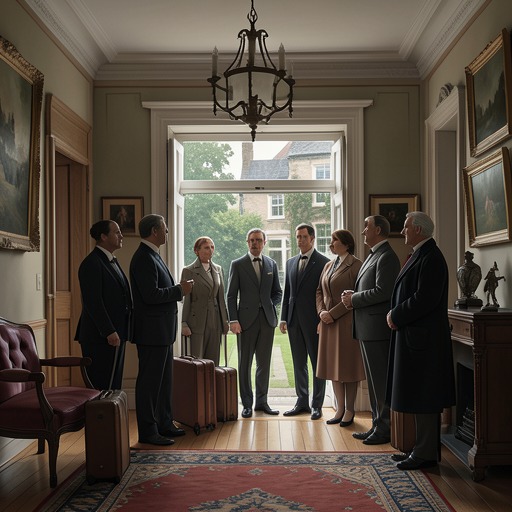
Mme de Cambremer-Legrandin
In Search of Lost TimeMme de Cambremer-Legrandin, the younger Marquise de Cambremer and Legrandin’s sister, is a socially alert but inconsistent figure whose politeness and artistic opinions change with the audience she hopes to impress. Through her exchanges with the narrator, Albertine, her mother-in-law, and the Verdurin circle, the novel shows taste and courtesy functioning not as stable personal qualities but as instruments of social distinction.
Social Position and Changing Manners
At the hotel in Balbec, Mme de Cambremer-Legrandin treats the narrator with conspicuous warmth because Robert de Saint-Loup has identified him as a friend of the Guermantes. Her welcome contrasts with the curt manner she would have used had she encountered him through her brother Legrandin. The difference makes social connection, rather than any change in the visitor himself, the measure of her courtesy: she smiles freely when she believes a prestigious association is at stake.
Her relation with her mother-in-law is markedly less courteous. While the older Marquise speaks modestly of her family’s country origins, Mme de Cambremer-Legrandin interrupts to assert the family’s historical standing, citing its heraldic window at Bayeux Cathedral and tombs in the principal church at Avranches. She also tells the narrator about a priest who researched local charters and place-names, and offers to send him his pamphlet on the surroundings of Féterne. The exchange shows her using historical scholarship to enhance the family’s claims while rebuking her mother-in-law for understating them.
The same struggle over position appears in the family’s changing account of La Raspelière. Since the Cambremers have let the estate to the Verdurins, its former advantage—a commanding view over both sea and valley—has, in retrospect, become the inconvenience of having to go uphill or downhill. Mme de Cambremer-Legrandin presents Féterne as the superior place and celebrates the sea’s nearness there, although her enthusiasm follows the family’s change of residence. The shifting evaluation suggests how readily an apparent judgment of place can adjust to altered circumstances and advantage.
Taste as Social Performance
Mme de Cambremer-Legrandin’s declarations about art reveal the same dependence on fashion. She considers herself advanced and insists that, in art, one can never be far enough to the Left. In music, she treats development as a single progressive line, placing Debussy beyond Wagner. The narrator’s account undercuts this confidence: artists may use what they have taken from predecessors in order eventually to move beyond them, while artistic theories and schools rise and fall rather than advancing in a simple succession.
Her attitude toward her mother-in-law’s playing makes that hierarchy personal. The older Marquise says she was raised in the worship of Chopin and offers to play for the narrator, while acknowledging that Chopin no longer appeals to the younger generation. Mme de Cambremer-Legrandin grants that her mother-in-law has technique and plays the notes correctly, but denies that this makes her a musician. Her dismissal is not presented as a neutral assessment: it reflects a fashionable doctrine that she has adopted along with her claim to being artistically advanced.
She likewise tells the narrator that she values natural gifts over acquired knowledge, praising Palamède de Charlus as naturally talented and saying that Brichot interests her less, despite his lively learning. The narrator points out the irony: the very woman who disparages learning has acquired the opinion that knowledge matters little and originality matters more. Her pose of spontaneity is itself learned, exposing how cultural authority can be performed through the appearance of rejecting education.
Encounters and Narrative Significance
When Mme de Cambremer-Legrandin discusses Claude Monet’s water-lilies, Albertine recognizes them as the series Elstir had described and speaks enthusiastically of the paintings she has seen in Amsterdam. Mme de Cambremer-Legrandin asks whether Albertine knows Vermeer, delivering the question in the imperious tone she might use to ask whether someone knows the Guermantes. Albertine misunderstands the name as referring to living people, but the mistake passes unnoticed. The scene links artistic knowledge to the same social testing that governs her manners: a question about painters can operate like a test of acquaintance and rank.
Her remarks on art and learning also illuminate the narrator’s uncertain position among social groups. At a Verdurin gathering, he is not part of the little clan and fails to recognize the ridicule that Brichot’s etymological talk provokes. Mme Verdurin sees that he has been taken in by Brichot, just as Mme de Guermantes had earlier judged him foolish for enjoying himself at Mme d’Arpajon’s. His response reveals that what interests him in Brichot’s explanations is not necessarily what a circle values as wit or social ease. Against that background, Mme de Cambremer-Legrandin’s shifting standards become part of a wider portrait of taste as a code whose meaning changes with the group that applies it.